
When Your Environment Stops Matching Who You’re Becoming
Cleaning my office didn’t make me want a tidier space. It made me realize the room was designed for a version of me that no longer exists. Once the clutter was gone, the deeper truth surfaced: this wasn’t about neatness; it was about alignment. A full transformation begins now.
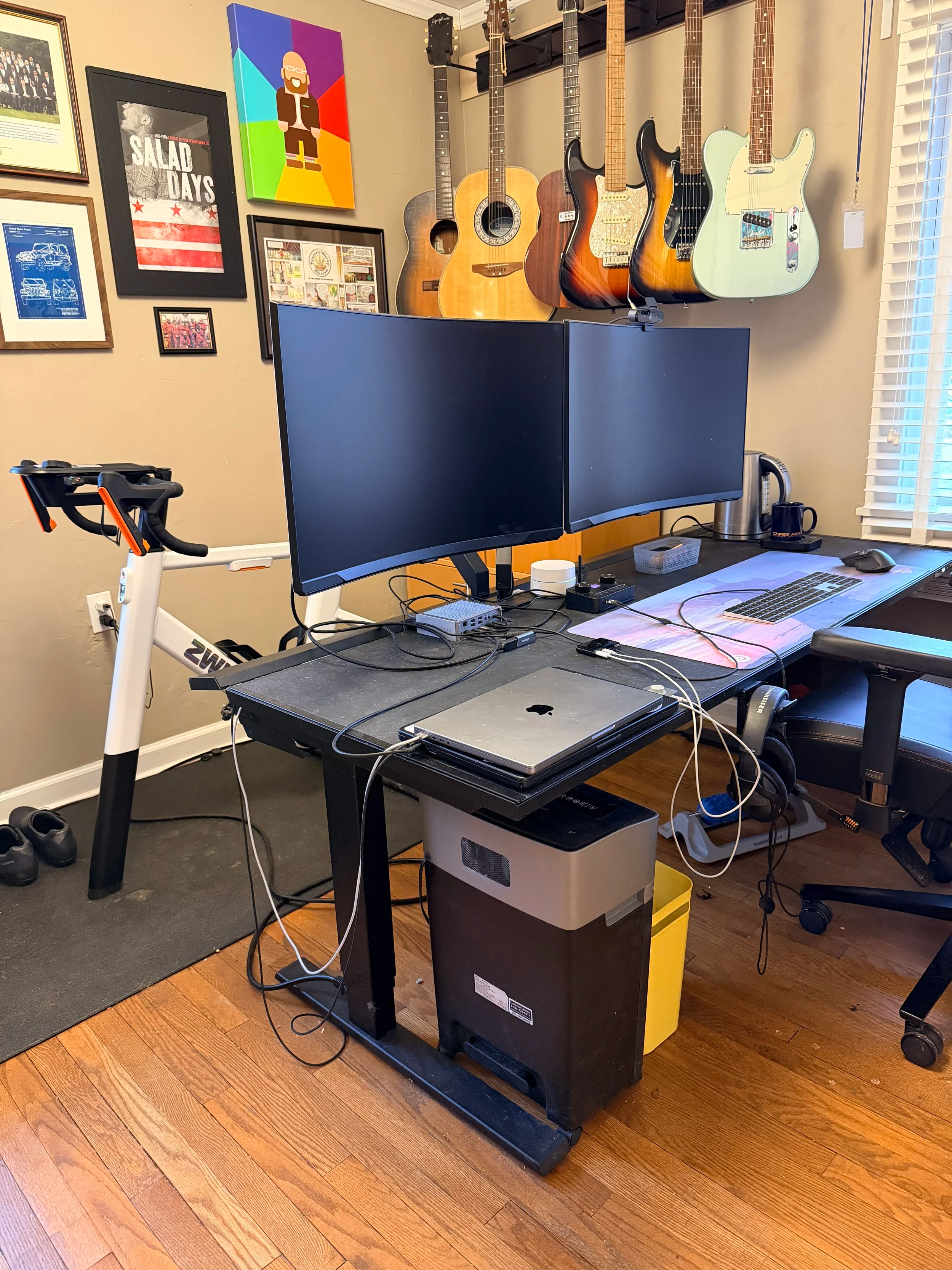
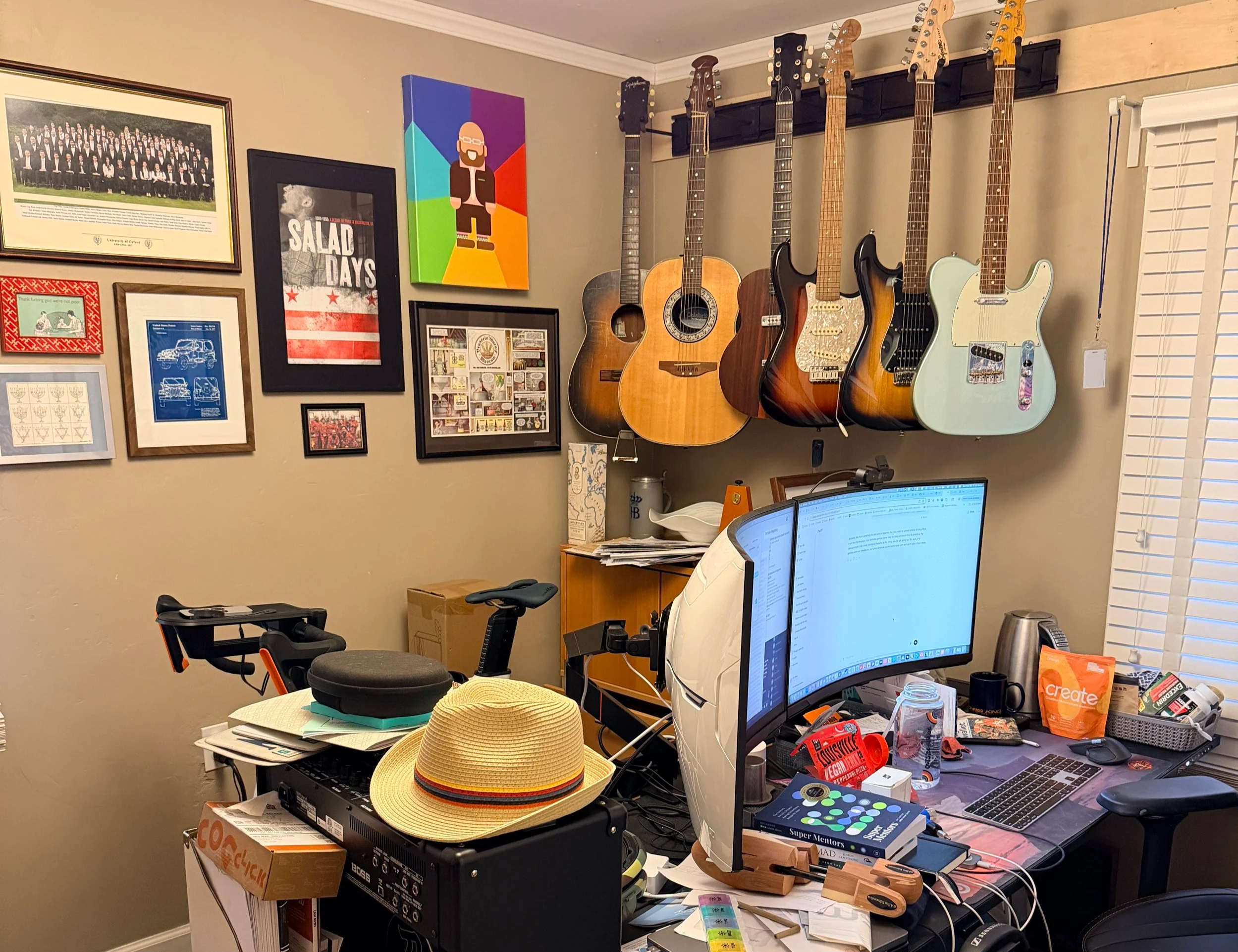
Last week I posted a photo of my office: cables everywhere, stacks of papers doing their best impression of geological sediment, guitars half-hidden behind clutter. I said I’d clean it and share an “after” photo in seven days.
I kept my word. The office is cleaner. Surfaces exist again. The floor is visible. The Zwift bike is no longer wedged between competing piles of entropy. The guitars look curated instead of trapped. The room feels like it’s breathing again.
But something else happened… something I didn’t expect.
Cleaning the office didn’t make me want a tidier office.
It made me want a different office.
Because once I cleared away the noise, I could finally see the underlying system. What I thought was a mess was actually a design problem. A room that had evolved through convenience, not intention.
Long before I became an operator, before I taught, before I began writing Thinking Design, I spent years studying the semiotics of the built environment: how space communicates meaning, how architecture shapes cognition, how physical form influences the stories we tell ourselves about who we are.
In grad school I even designed my own electives around the philosophy of architecture. I worked as a docent at the National Building Museum. For a while I seriously considered applying to Harvard GSD or MIT to study architecture formally. Space—and the messages it sends—has always mattered to me.
So when I cleared my desk last week, it didn’t feel like tidying.
It felt like uncovering the underlying logic of a system.
The room wasn’t messy; it was misaligned.
It reflected a previous version of me, not the one I’m actively building.
And suddenly the question shifted from
“How do I make this room neater?”
to
“What space do I need to become the person I’m trying to become?”
It landed with surprising force.
I’m training for the Tour Divide—an unreasonable ride that demands transformation. I’m writing a book about design and the way shallow understanding leads systems astray. I’m re-architecting my career and identity after a long stretch of chronic pain and constraint.
Why wouldn’t my environment need to change too?
Spaces are not neutral. They shape how we think, how we work, how we see ourselves. They reinforce our habits or resist them. They either expand our capacity or shrink it.
My current office was built for a Ken who no longer exists.
The new one needs to reflect:
A writer who is building a book
A systems thinker who values clarity of environment
An athlete-in-progress rebuilding a body
An operator who needs calm, focus, and intentionality
A person who is choosing the long arc rather than the short fix
So yes, the office is clean now. But that was just the threshold—not the destination.
The real work begins with transformation:
New layout.
New palette.
New lighting.
Zones for deep work, creative flow, and training.
A space designed, not drifted into.
A space that supports the life I’m building, rather than reminding me of the one I’m leaving behind.
Sometimes a small act—even cleaning a room—reveals a deeper truth:
you’re not just reorganizing your environment; you’re reorganizing yourself.
If Tour de Ken is about designing a life capable of crossing 2,700 miles of mountain passes, then the place where that design work happens matters too.
The office is next.
Ken Wake is a designer-philosopher, entrepreneur, EIR and Professor at Georgetown University, and founder of Watershed LLC. He is training for the 2,745-mile Tour Divide before he turns 50.
Starting the Cleanup: Design Meets Reality
I had planned to spend this weekend fully reorganizing my office.
I imagined the whole transformation: papers sorted, books ordered, shelves reset, cables tamed, a room built to support deep work and long-arc thinking.
And then life intervened.
Work deadlines expanded. Family needs shifted. Energy dipped. The time I thought I had evaporated, and instead of a full reset, I ended up somewhere in between: a few piles sorted, a bit of space reclaimed, a sense of direction but not the finish line.
A younger version of me would have treated this as failure.
I don’t see it that way anymore.
Design Is Usually What Happens After the Plan Breaks
This weekend reminded me of something I have to relearn regularly: design is not the pursuit of perfect execution. It’s the practice of adjusting constraints in real time.
We often pretend that progress comes from pristine plans, uninterrupted hours, and ideal conditions. But the truth—especially for those of us redesigning bodies, careers, or identities—is that most meaningful change happens in the messier middle.
You start.
Life pushes back.
You adapt.
You build a system flexible enough to absorb reality without losing direction.
Cleaning my office became a small example of the larger work I’m doing with Tour de Ken. I didn’t complete the transformation this weekend, but I did something just as important: I began shaping the context that will shape me. Even if it was imperfect. Even if the full redesign has to wait a bit longer.
Context Shapes Behavior, Even When It’s Not Finished
Here’s the part that surprised me: even the partial cleanup changed the energy of the room.
A small cleared surface made space for thinking.
A rearranged shelf brought the Thinking Design materials closer.
A decluttered corner made me breathe differently.
Design often works like that. You don’t need the whole system to change at once. You need enough change to shift momentum, to make future effort easier.
I’ll finish it next weekend. That’s the plan. But even if the plan bends again, I’ll keep returning to it until the space matches the identity I’m building.
Because the truth is simple: A room doesn’t need to be finished to start redesigning you.
This Week: Incomplete Is Still Progress
I’m sharing this because I think more people need to hear it: you don't have to be perfect to be moving forward.
Training for the Tour Divide has taught me this. Writing a book has taught me this. Chronic pain has forced me to learn this. And now something as mundane as cleaning my office is reflecting it back at me.
When life interrupts your plans, it isn’t a sign to stop.
It’s a chance to practice design under actual conditions.
Next week, I’ll share the “after” shot—whatever form that takes. Maybe I’ll finish the room. Maybe I’ll get halfway again. Maybe I’ll discover a new constraint I didn’t know I had.
Either way, the process will continue.
And the environment will keep shifting with me.
Ken Wake is a designer-philosopher, entrepreneur, EIR and Professor at Georgetown University, and founder of Watershed LLC. He is training for the 2,745-mile Tour Divide before he turns 50.