The Pedals I Chose, and the Body for Which I Have to Design
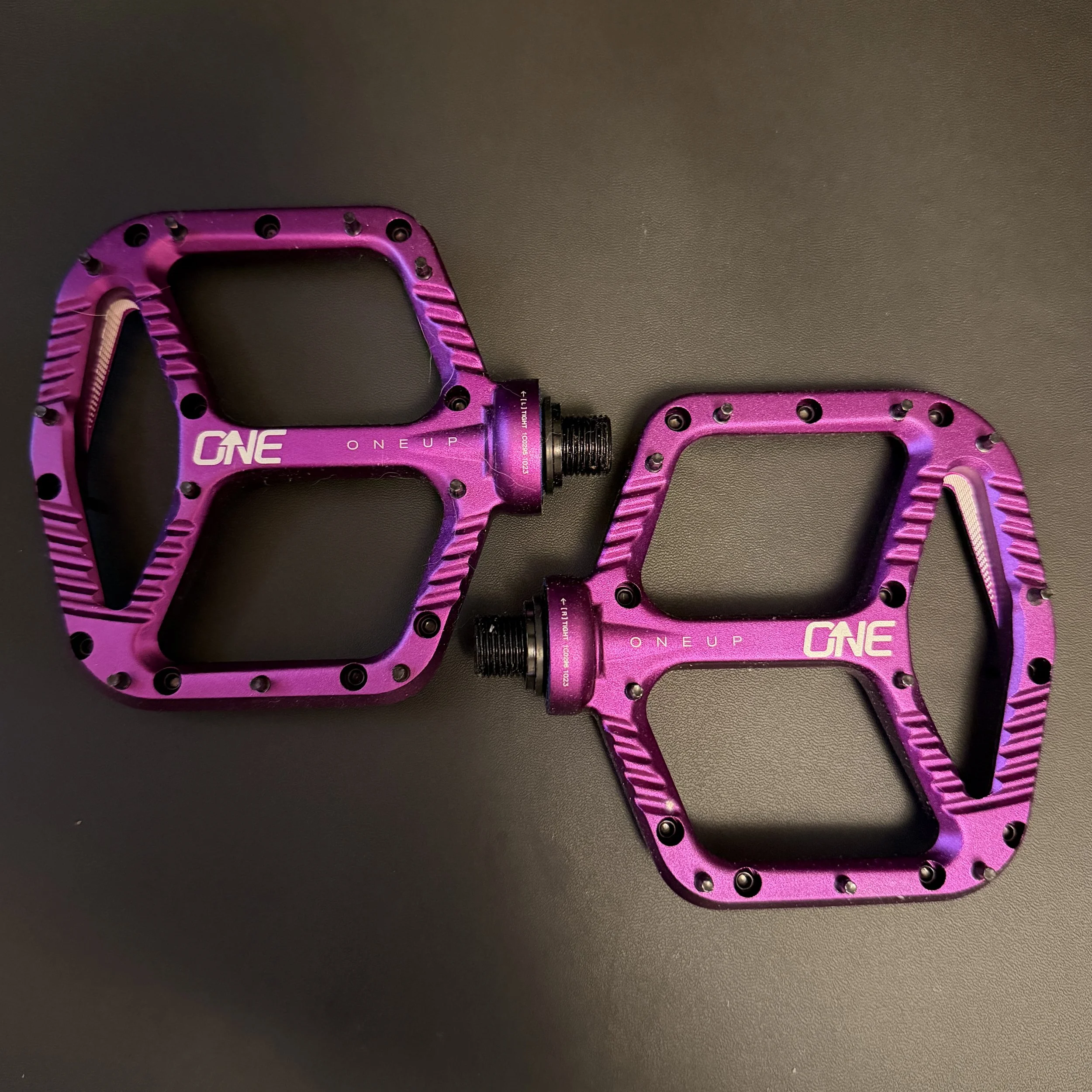
These pedals look like a small equipment choice. They aren’t. They reflect years of injury, adaptation, and learning what it means to design around a body that does not behave like the ideal case. This is a story about safety, constraint, and choosing truth over optimization.
To most people, these probably look like pedals.
Nice ones. Purple ones. Components.
To me, they represent something far more specific: a commitment to designing for the body I actually have, not the one I remember or wish I still did.
I cannot comfortably ride clipless pedals.
That sentence alone carries more weight than it should.
For most serious cyclists, clipless pedals are not a choice; they are a given. They signal legitimacy. Intent. Belonging. But for me, they are also unsafe. Years of foot deformity, chronic pain, and a surgical fusion have left me with limited mobility and delayed reaction in my left foot. Clipping out quickly, reliably, under fatigue is not guaranteed. In ultra-distance riding, that uncertainty becomes risk.
And risk compounds.
So I chose flat pedals.
Not as a concession.
As a design decision.
This is what rebuilding a life looks like when you take constraints seriously. Not abstractly. Not symbolically. Physically.
The hardest part of long recovery is not pain; it is identity drift. You spend years knowing exactly who you are, and then one day your body stops cooperating with the story. You can either chase the old narrative harder, or you can slow down and redesign.
Flat pedals force a different relationship with the bike. With effort. With precision. With fatigue. They demand constant attention. They make you honest about power, positioning, and limits. They also let me ride safely, confidently, and for long stretches without fear of being trapped in the wrong moment.
These pedals are not about compromise.
They are about alignment.
Design thinking often fails because it ignores lived reality in favor of elegance. This is the opposite move. It is inelegant. It is specific. It is grounded in a body that has scars, limitations, and a future worth protecting.
Every small choice like this commits you to a direction. Not a destination, but a trajectory.
These pedals tell me something important every time I look at them:
I am not trying to become who I was.
I am building who I can be.
And that distinction changes everything.
Designing for Friction, Not Flow
Not all resistance is a failure of design. Some friction is protective, instructive, even necessary. This essay explores why designing for smoothness often breaks under real-world constraints—and why the right kind of friction can make systems, bodies, and decisions more resilient.
There is a persistent fantasy embedded in modern design culture: that the best systems are frictionless.
Smooth. Elegant. Effortless.
We celebrate flow states, seamless interfaces, and invisible infrastructure. When something resists us, we assume it is broken. When something slows us down, we assume it needs optimization.
I no longer believe that.
Training again, with a body shaped by injury and adaptation, has forced me to confront a harder truth: some friction is not a flaw. It is information.
My body offers constant feedback now. Not always politely. Pain, fatigue, hesitation, imbalance. These are not signals to be ignored or engineered away. They are constraints that must be designed with, not around.
This is as true in physical systems as it is in organizations.
Many of the failures I’ve seen in healthcare, technology, and social systems come from mistaking resistance for inefficiency. We design as if people are abstractions. As if context is noise. As if the real world should behave more like the model.
It never does.
On the bike, friction shows up immediately. You feel it in your feet, your cadence, your breathing. You cannot intellectualize your way past it. You must respond. Adjust posture. Change pacing. Choose differently.
That is what makes it honest.
I’m beginning to see this phase of my life as a deliberate reintroduction of friction. Not to suffer for its own sake, but to recover sensitivity. To rebuild judgment. To regain trust in feedback that cannot be gamed.
Design that ignores friction creates brittle systems.
Design that listens to it creates resilient ones.
This is what I’m practicing now. On the bike. In my work. In the quiet restructuring of my days.
Not chasing flow, but learning when resistance is telling me something essential.
Ken Wake is a designer-philosopher, entrepreneur, EIR and Professor at Georgetown University, and founder of Watershed LLC. He is training for the 2,745-mile Tour Divide before he turns 50.
Why Small Choices Are Doing the Heavy Lifting Now
Big transformations rarely begin with dramatic decisions. They start with small, unglamorous choices that quietly reshape systems over time. This is a reflection on rebuilding capacity through constraint, attention, and design in the real world.
It’s tempting to believe that change happens at moments of declaration. The big decision. The public commitment. The dramatic pivot.
But that is not how systems actually change.
They change through small, repeated choices that reshape what is possible over time.
Cleaning an office.
Choosing pedals.
Showing up for another ride when motivation is low.
Writing even when clarity hasn’t fully arrived.
None of these things transform a life on their own. Together, they alter the system you’re living inside.
This is something I’ve learned repeatedly as an operator, and I’m relearning it now in my body. Systems respond less to intention than to structure. If you want different outcomes, you need different constraints, defaults, and feedback loops.
Right now, my life is full of small, almost boring decisions that point in the same direction. They are not heroic. They are not optimized. They are simply aligned.
Alignment is underrated.
When your environment, your tools, your routines, and your goals begin reinforcing one another, progress becomes quieter but more durable. You stop relying on motivation and start relying on design.
That’s what this phase of Tour de Ken is really about.
Not proving anything.
Not reclaiming an identity through nostalgia.
But constructing a system that makes becoming possible again.
The big milestones will come later. For now, the work lives here, in the details most people overlook.
And that’s exactly where real change likes to hide.
Ken Wake is a designer-philosopher, entrepreneur, EIR and Professor at Georgetown University, and founder of Watershed LLC. He is training for the 2,745-mile Tour Divide before he turns 50.
When Your Environment Stops Matching Who You’re Becoming
Cleaning my office didn’t make me want a tidier space. It made me realize the room was designed for a version of me that no longer exists. Once the clutter was gone, the deeper truth surfaced: this wasn’t about neatness; it was about alignment. A full transformation begins now.
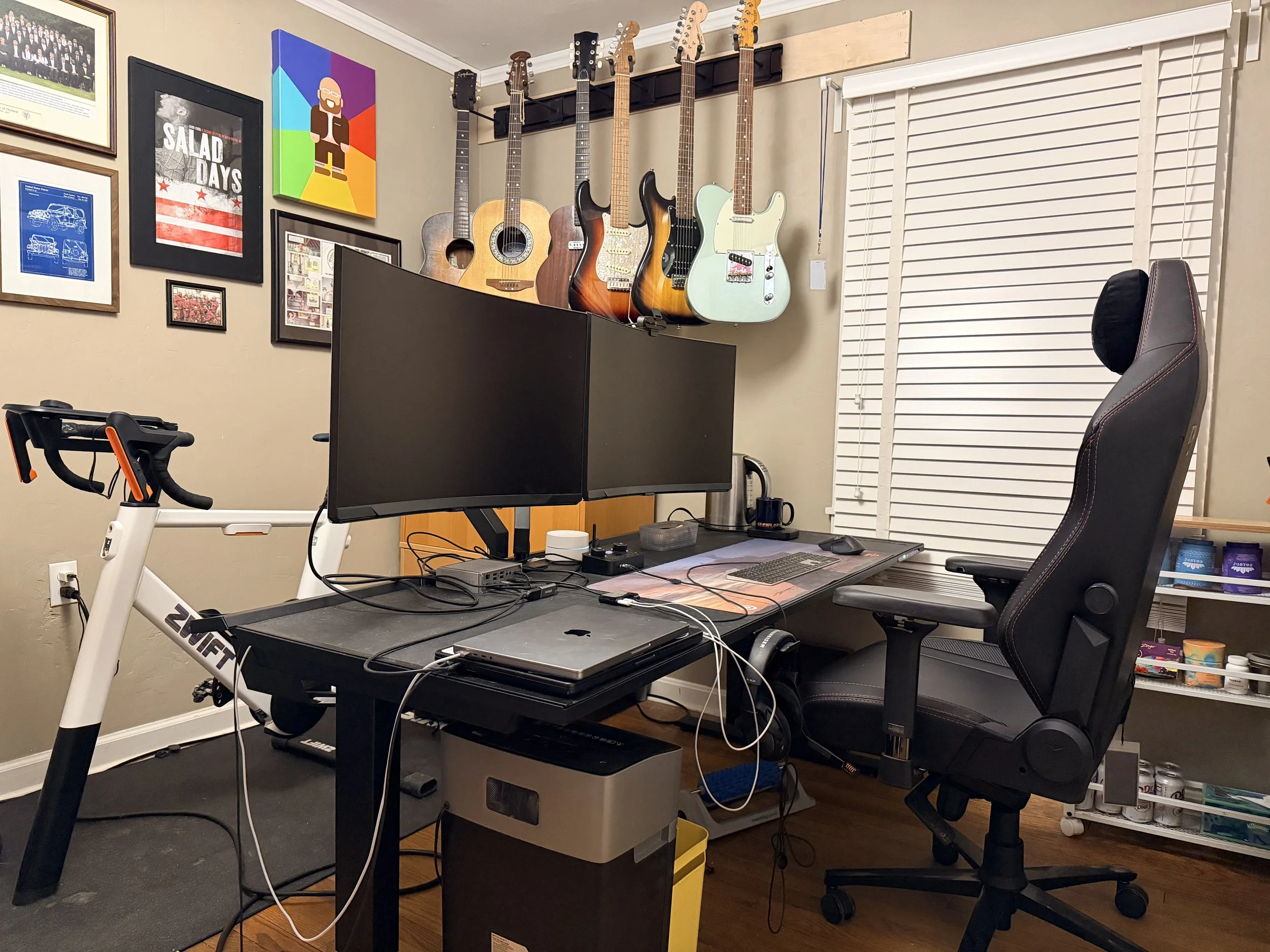
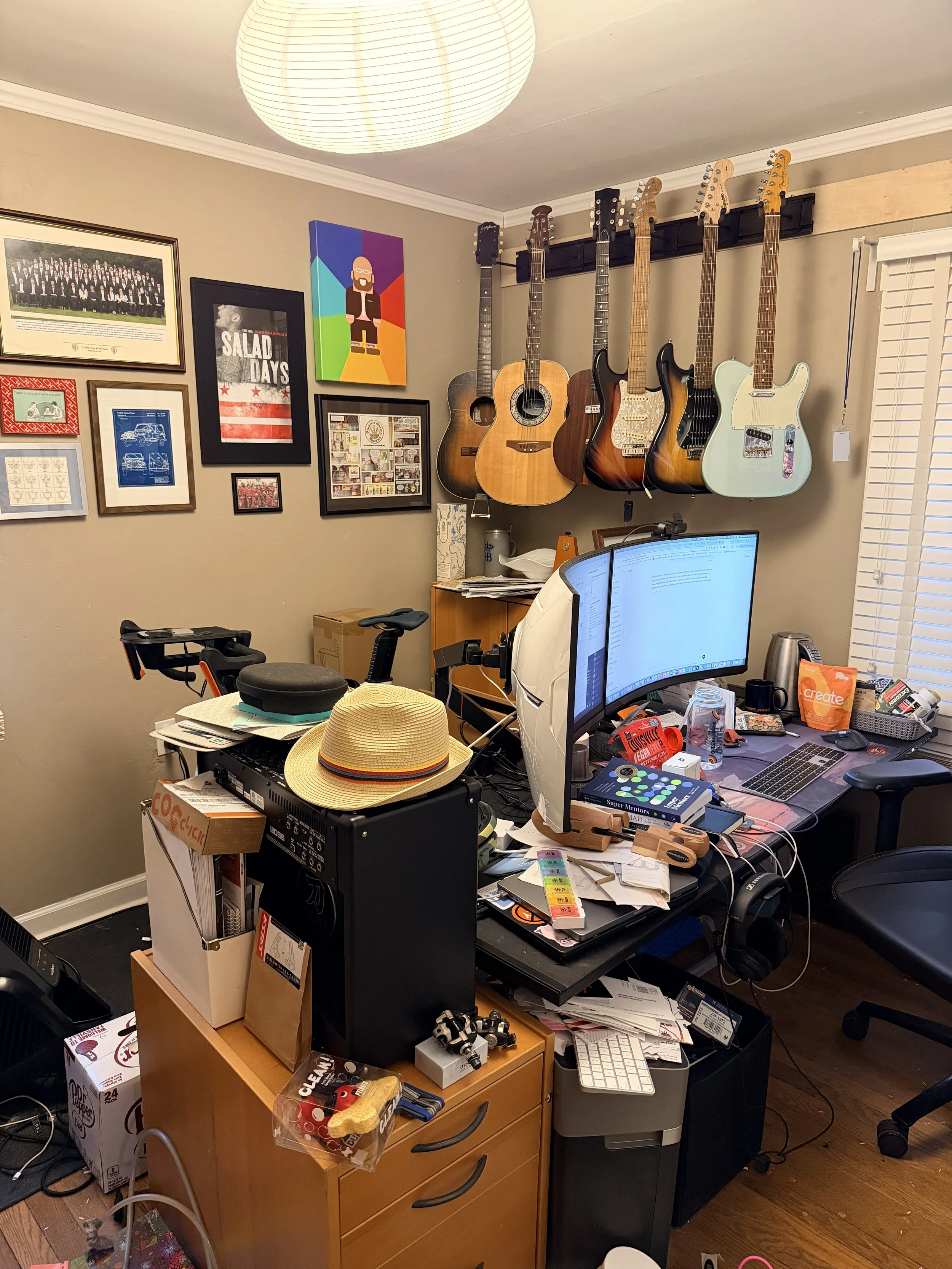
Last week I posted a photo of my office: cables everywhere, stacks of papers doing their best impression of geological sediment, guitars half-hidden behind clutter. I said I’d clean it and share an “after” photo in seven days.
I kept my word. The office is cleaner. Surfaces exist again. The floor is visible. The Zwift bike is no longer wedged between competing piles of entropy. The guitars look curated instead of trapped. The room feels like it’s breathing again.
But something else happened… something I didn’t expect.
Cleaning the office didn’t make me want a tidier office.
It made me want a different office.
Because once I cleared away the noise, I could finally see the underlying system. What I thought was a mess was actually a design problem. A room that had evolved through convenience, not intention.
Long before I became an operator, before I taught, before I began writing Thinking Design, I spent years studying the semiotics of the built environment: how space communicates meaning, how architecture shapes cognition, how physical form influences the stories we tell ourselves about who we are.
In grad school I even designed my own electives around the philosophy of architecture. I worked as a docent at the National Building Museum. For a while I seriously considered applying to Harvard GSD or MIT to study architecture formally. Space—and the messages it sends—has always mattered to me.
So when I cleared my desk last week, it didn’t feel like tidying.
It felt like uncovering the underlying logic of a system.
The room wasn’t messy; it was misaligned.
It reflected a previous version of me, not the one I’m actively building.
And suddenly the question shifted from
“How do I make this room neater?”
to
“What space do I need to become the person I’m trying to become?”
It landed with surprising force.
I’m training for the Tour Divide—an unreasonable ride that demands transformation. I’m writing a book about design and the way shallow understanding leads systems astray. I’m re-architecting my career and identity after a long stretch of chronic pain and constraint.
Why wouldn’t my environment need to change too?
Spaces are not neutral. They shape how we think, how we work, how we see ourselves. They reinforce our habits or resist them. They either expand our capacity or shrink it.
My current office was built for a Ken who no longer exists.
The new one needs to reflect:
A writer who is building a book
A systems thinker who values clarity of environment
An athlete-in-progress rebuilding a body
An operator who needs calm, focus, and intentionality
A person who is choosing the long arc rather than the short fix
So yes, the office is clean now. But that was just the threshold—not the destination.
The real work begins with transformation:
New layout.
New palette.
New lighting.
Zones for deep work, creative flow, and training.
A space designed, not drifted into.
A space that supports the life I’m building, rather than reminding me of the one I’m leaving behind.
Sometimes a small act—even cleaning a room—reveals a deeper truth:
you’re not just reorganizing your environment; you’re reorganizing yourself.
If Tour de Ken is about designing a life capable of crossing 2,700 miles of mountain passes, then the place where that design work happens matters too.
The office is next.
Ken Wake is a designer-philosopher, entrepreneur, EIR and Professor at Georgetown University, and founder of Watershed LLC. He is training for the 2,745-mile Tour Divide before he turns 50.
Starting the Cleanup: Design Meets Reality
I had planned to spend this weekend fully reorganizing my office.
I imagined the whole transformation: papers sorted, books ordered, shelves reset, cables tamed, a room built to support deep work and long-arc thinking.
And then life intervened.
Work deadlines expanded. Family needs shifted. Energy dipped. The time I thought I had evaporated, and instead of a full reset, I ended up somewhere in between: a few piles sorted, a bit of space reclaimed, a sense of direction but not the finish line.
A younger version of me would have treated this as failure.
I don’t see it that way anymore.
Design Is Usually What Happens After the Plan Breaks
This weekend reminded me of something I have to relearn regularly: design is not the pursuit of perfect execution. It’s the practice of adjusting constraints in real time.
We often pretend that progress comes from pristine plans, uninterrupted hours, and ideal conditions. But the truth—especially for those of us redesigning bodies, careers, or identities—is that most meaningful change happens in the messier middle.
You start.
Life pushes back.
You adapt.
You build a system flexible enough to absorb reality without losing direction.
Cleaning my office became a small example of the larger work I’m doing with Tour de Ken. I didn’t complete the transformation this weekend, but I did something just as important: I began shaping the context that will shape me. Even if it was imperfect. Even if the full redesign has to wait a bit longer.
Context Shapes Behavior, Even When It’s Not Finished
Here’s the part that surprised me: even the partial cleanup changed the energy of the room.
A small cleared surface made space for thinking.
A rearranged shelf brought the Thinking Design materials closer.
A decluttered corner made me breathe differently.
Design often works like that. You don’t need the whole system to change at once. You need enough change to shift momentum, to make future effort easier.
I’ll finish it next weekend. That’s the plan. But even if the plan bends again, I’ll keep returning to it until the space matches the identity I’m building.
Because the truth is simple: A room doesn’t need to be finished to start redesigning you.
This Week: Incomplete Is Still Progress
I’m sharing this because I think more people need to hear it: you don't have to be perfect to be moving forward.
Training for the Tour Divide has taught me this. Writing a book has taught me this. Chronic pain has forced me to learn this. And now something as mundane as cleaning my office is reflecting it back at me.
When life interrupts your plans, it isn’t a sign to stop.
It’s a chance to practice design under actual conditions.
Next week, I’ll share the “after” shot—whatever form that takes. Maybe I’ll finish the room. Maybe I’ll get halfway again. Maybe I’ll discover a new constraint I didn’t know I had.
Either way, the process will continue.
And the environment will keep shifting with me.
Ken Wake is a designer-philosopher, entrepreneur, EIR and Professor at Georgetown University, and founder of Watershed LLC. He is training for the 2,745-mile Tour Divide before he turns 50.
The Moment I Realized Shallow Understanding Runs Deep
One ordinary Monday morning taught me a lesson I’d need months later: shallow understanding feels safe, but it’s where our best intentions quietly drift off course.
Most lessons don’t announce themselves. They slip in quietly, disguised as something forgettable—a stray comment, a half-formed idea, a meeting you almost slept through.
This one arrived on a gray Monday morning, months before I ever imagined riding the Tour Divide or rebuilding myself mile by mile. Back then, I was holding the pieces of my life together the best I could. My body hurt constantly. My mind was stretched thin. I was working hard but not always wisely, and I had only the faintest hint of the language needed for the deeper shift that was coming.
Then came the Culture Pass.
It surfaced during a senior leadership meeting—one of those mornings when the screen glows brighter than you feel, the dogs bark at absolutely nothing, and you sip lukewarm tea because somehow you’re already behind.
Darin, our CEO—sharp, caring, intellectually earnest—came in energized. He’d been thinking all weekend, and you could feel it. He described the idea: give our members access to museums, concerts, cultural events. Something enriching. Uplifting. Affirming. A gesture of dignity. A marker of care.
And it made sense. A handful of members had said they wanted more activities and outings. Not many. Not loudly. But enough that you could build a story around it if you wanted to.
Maybe that was the problem: the story came too easily.
I remember the little choreography of alignment that happens instinctively on Zoom: people leaning in, nodding, smiling in that way that signals “I’m with you” even when they’re still trying to understand where “with you” is.
It would have been easy to nod too.
Move fast. Turn a suggestion into a narrative. Turn a narrative into a strategy.
But something felt off. Not dramatically. Just...off, like a single string out of tune in an otherwise stable chord.
I sat with it.
Then I said, “I think we should slow down. I’m not sure the logic holds across the populations we serve.”
The room paused. Not a heavy pause—just a subtle shift in momentum, the kind that reveals speed is not the same thing as progress.
The idea didn’t die. It simply exhaled. It went from “this is obviously the right thing” to “wait…what are we actually seeing?”
And that was enough.
I didn’t know it then, but that morning would become one of the small turning points I carried with me into later seasons of my life. A moment that taught me something I would need months later, when I decided to ride the Tour Divide and rebuild myself from the ground up:
Shallow understanding is the easiest kind to trust, and the most dangerous kind to follow.
Nothing in that meeting was malicious. No one was careless. Everyone was acting in good faith. And still, the idea drifted away from reality faster than anyone noticed.
Why?
Because momentum is seductive. Alignment feels moral. A good narrative can outrun the truth by miles.
And because it’s easier to believe we see clearly than to admit we might be wrong.
In the months that followed, I kept returning to that morning—not because the Culture Pass was a bad idea, but because it revealed something truer:
We were responding to the surface of what we heard, not the depth of what our members lived.
They didn’t need concerts. They needed something harder to name. Something structural. Something deeper.
I hadn’t yet fully formed the language for this then—not the systems, incentives, and constraints that shape behavior in the real world. I hadn’t begun rebuilding my life or my body. I hadn’t started training again. I hadn’t dreamed of mountain passes or long gravel miles or the version of myself I’m trying to become now.
But that morning planted the seed.
A lesson I wouldn’t fully understand until much later:
The difference between shallow and deep understanding isn’t intellectual. It’s moral. It’s about attention. It’s about the discipline of seeing the world as it is, not as we wish it to be.
Tour de Ken, in many ways, is my attempt to live by that discipline. To train in it. To build a life around it.
Not just on the bike, but everywhere—at work, in my relationships, and in the quiet parts of my mind where the real conversations happen.
The Culture Pass wasn’t a failure. It was a mirror.
It showed me how easy it is to reach for the quick explanation, the comforting clarity, the tidy narrative. And how quietly, almost imperceptibly, we drift off course when we do.
I didn’t know it then, but I know it now:
The shallows aren’t safe. They just feel that way.
Ken Wake is a designer-philosopher, entrepreneur, EIR and Professor at Georgetown University, and founder of Watershed LLC. He is training for the 2,745-mile Tour Divide before he turns 50.
Why I’m Riding the Tour Divide Before I Turn 50… and What It Has to Do With Redesigning a Life
I’ve been thinking a lot about thresholds lately. Some thresholds you choose; some choose you. A year ago, I was limping through airports with a cane, navigating chronic pain from a pair of malformed ankles and a surgical fusion that seemed to have traded one problem for another. Walking hurt. Standing hurt. Most days, just being upright hurt.
Cycling—the sport that once shaped whole chapters of my life—was something I watched other people do.
And then something shifted. Not in a Hollywood moment of inspiration, but slowly, like a tide turning. I realized that if I wanted the next decade of my life to belong to me, I had to design it. Not dream about it. Not intellectualize it. Design it. With constraints, with embodied reality, with the physics of the world and the mechanics of my own body fully acknowledged.
So I decided to train for the Tour Divide: 2,745 miles from Banff, AB to Antelope Wells, NM on the Mexican border. Mountains. Weather. Bears. Isolation. A race so brutally indifferent it never cares who you were before you started.
It’s an unreasonable decision. That’s the point.
Rebuilding a Body, Rebuilding a Self
I’m doing this at 49, after gaining over 100 pounds, after years of chronic pain, after losing the athletic identity I once took for granted. I’m not supposed to be doing this. My ankles aren’t supposed to tolerate it. My schedule doesn’t allow for it. My life is full: family, work, teaching, writing, building companies.
But here’s the deeper truth: I need a project that demands everything from me—physically, mentally, emotionally—because those projects reforge identity. They give you the chance to become someone you haven’t met yet.
Training for this race has already forced me to rethink capability. Systems. Constraints. Time. Energy. Pain. Failure. Motivation. The physical becomes philosophical very quickly when your body becomes your primary design material.
The Tour de Ken Is Not Really About Cycling
This blog, Tour de Ken, isn’t a cycling diary. If it were, I’d have no interest in writing it and you’d have no interest in reading it. This isn’t an homage to gear ratios or wattage.
This is a chronicle of long-arc design, of what happens when you choose a target far enough away that you must become a different person in order to reach it.
The Tour Divide is the spine of the story, but the story is about:
Self-authorship after a period of loss and limitation
How systems thinking looks when applied to a body in motion rather than an organization on paper
Identity reconstruction
Endurance as a philosophy
What it means to pursue something wildly hard, purely because you want to see who you become on the way
Why Start Writing Now?
Because journeys only feel linear in retrospect.
Right now I’m in the middle of the messy part: losing weight, rebuilding fitness, learning how to manage pain, rediscovering discipline, figuring out how to train with a full life.
I want to document the reality—the wins, the setbacks, the theories, the data, the discipline, the doubt—not because I have answers, but because I’m committed to the process.
This blog will cover:
Training updates, honest ones
Reflections on identity and embodied design
Lessons in systems thinking from the saddle
How I’m re-architecting my life to make room for this
And the intersections with my other major project right now: writing a book about the failures of design thinking and what a more situated, rigorous practice looks like
The Journey Ahead
In 2027—the summer before I turn 50—I plan to stand at the trailhead in Banff, look south, and start pedaling. My goal is simple: to finish. To hug my family and my four dogs at the end. To prove to myself that I can redesign a life from first principles, starting from a place that once felt nearly impossible.
If you want to follow along, subscribe. Or don’t… I’m doing this either way. But if you’re here, I’m glad. I hope something in this project sparks something in your own.
Because the truth is, every one of us is riding some version of our own Divide.
And this one is mine.
Ken Wake is a designer-philosopher, entrepreneur, EIR and Professor at Georgetown University, and founder of Watershed LLC. He is training for the 2,745-mile Tour Divide before he turns 50.