
Starting the Cleanup: Design Meets Reality
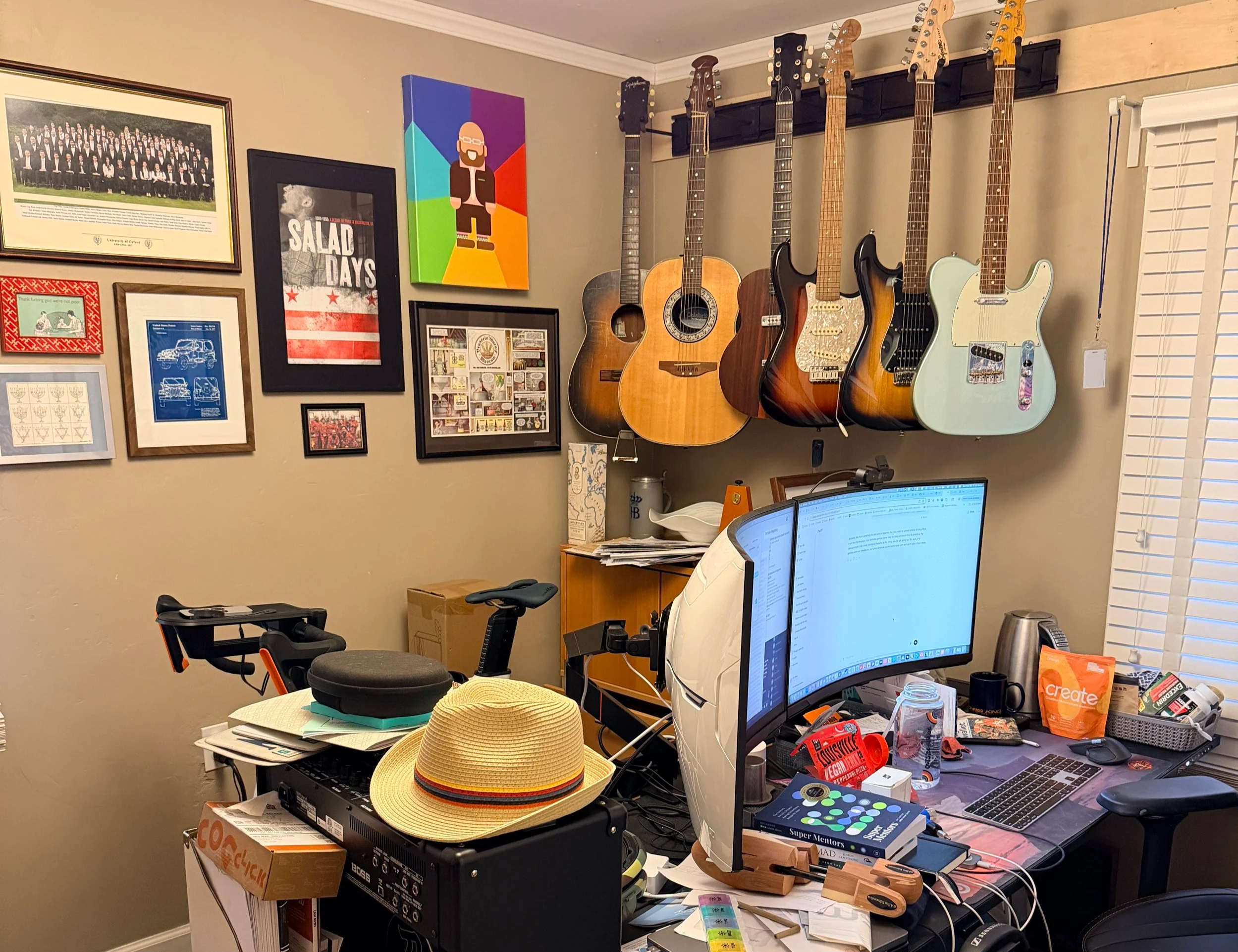
I had planned to spend this weekend fully reorganizing my office.
I imagined the whole transformation: papers sorted, books ordered, shelves reset, cables tamed, a room built to support deep work and long-arc thinking.
And then life intervened.
Work deadlines expanded. Family needs shifted. Energy dipped. The time I thought I had evaporated, and instead of a full reset, I ended up somewhere in between: a few piles sorted, a bit of space reclaimed, a sense of direction but not the finish line.
A younger version of me would have treated this as failure.
I don’t see it that way anymore.
Design Is Usually What Happens After the Plan Breaks
This weekend reminded me of something I have to relearn regularly: design is not the pursuit of perfect execution. It’s the practice of adjusting constraints in real time.
We often pretend that progress comes from pristine plans, uninterrupted hours, and ideal conditions. But the truth—especially for those of us redesigning bodies, careers, or identities—is that most meaningful change happens in the messier middle.
You start.
Life pushes back.
You adapt.
You build a system flexible enough to absorb reality without losing direction.
Cleaning my office became a small example of the larger work I’m doing with Tour de Ken. I didn’t complete the transformation this weekend, but I did something just as important: I began shaping the context that will shape me. Even if it was imperfect. Even if the full redesign has to wait a bit longer.
Context Shapes Behavior, Even When It’s Not Finished
Here’s the part that surprised me: even the partial cleanup changed the energy of the room.
A small cleared surface made space for thinking.
A rearranged shelf brought the Thinking Design materials closer.
A decluttered corner made me breathe differently.
Design often works like that. You don’t need the whole system to change at once. You need enough change to shift momentum, to make future effort easier.
I’ll finish it next weekend. That’s the plan. But even if the plan bends again, I’ll keep returning to it until the space matches the identity I’m building.
Because the truth is simple: A room doesn’t need to be finished to start redesigning you.
This Week: Incomplete Is Still Progress
I’m sharing this because I think more people need to hear it: you don't have to be perfect to be moving forward.
Training for the Tour Divide has taught me this. Writing a book has taught me this. Chronic pain has forced me to learn this. And now something as mundane as cleaning my office is reflecting it back at me.
When life interrupts your plans, it isn’t a sign to stop.
It’s a chance to practice design under actual conditions.
Next week, I’ll share the “after” shot—whatever form that takes. Maybe I’ll finish the room. Maybe I’ll get halfway again. Maybe I’ll discover a new constraint I didn’t know I had.
Either way, the process will continue.
And the environment will keep shifting with me.
Ken Wake is a designer-philosopher, entrepreneur, EIR and Professor at Georgetown University, and founder of Watershed LLC. He is training for the 2,745-mile Tour Divide before he turns 50.

The Moment I Realized Shallow Understanding Runs Deep
One ordinary Monday morning taught me a lesson I’d need months later: shallow understanding feels safe, but it’s where our best intentions quietly drift off course.
Most lessons don’t announce themselves. They slip in quietly, disguised as something forgettable—a stray comment, a half-formed idea, a meeting you almost slept through.
This one arrived on a gray Monday morning, months before I ever imagined riding the Tour Divide or rebuilding myself mile by mile. Back then, I was holding the pieces of my life together the best I could. My body hurt constantly. My mind was stretched thin. I was working hard but not always wisely, and I had only the faintest hint of the language needed for the deeper shift that was coming.
Then came the Culture Pass.
It surfaced during a senior leadership meeting—one of those mornings when the screen glows brighter than you feel, the dogs bark at absolutely nothing, and you sip lukewarm tea because somehow you’re already behind.
Darin, our CEO—sharp, caring, intellectually earnest—came in energized. He’d been thinking all weekend, and you could feel it. He described the idea: give our members access to museums, concerts, cultural events. Something enriching. Uplifting. Affirming. A gesture of dignity. A marker of care.
And it made sense. A handful of members had said they wanted more activities and outings. Not many. Not loudly. But enough that you could build a story around it if you wanted to.
Maybe that was the problem: the story came too easily.
I remember the little choreography of alignment that happens instinctively on Zoom: people leaning in, nodding, smiling in that way that signals “I’m with you” even when they’re still trying to understand where “with you” is.
It would have been easy to nod too.
Move fast. Turn a suggestion into a narrative. Turn a narrative into a strategy.
But something felt off. Not dramatically. Just...off, like a single string out of tune in an otherwise stable chord.
I sat with it.
Then I said, “I think we should slow down. I’m not sure the logic holds across the populations we serve.”
The room paused. Not a heavy pause—just a subtle shift in momentum, the kind that reveals speed is not the same thing as progress.
The idea didn’t die. It simply exhaled. It went from “this is obviously the right thing” to “wait…what are we actually seeing?”
And that was enough.
I didn’t know it then, but that morning would become one of the small turning points I carried with me into later seasons of my life. A moment that taught me something I would need months later, when I decided to ride the Tour Divide and rebuild myself from the ground up:
Shallow understanding is the easiest kind to trust, and the most dangerous kind to follow.
Nothing in that meeting was malicious. No one was careless. Everyone was acting in good faith. And still, the idea drifted away from reality faster than anyone noticed.
Why?
Because momentum is seductive. Alignment feels moral. A good narrative can outrun the truth by miles.
And because it’s easier to believe we see clearly than to admit we might be wrong.
In the months that followed, I kept returning to that morning—not because the Culture Pass was a bad idea, but because it revealed something truer:
We were responding to the surface of what we heard, not the depth of what our members lived.
They didn’t need concerts. They needed something harder to name. Something structural. Something deeper.
I hadn’t yet fully formed the language for this then—not the systems, incentives, and constraints that shape behavior in the real world. I hadn’t begun rebuilding my life or my body. I hadn’t started training again. I hadn’t dreamed of mountain passes or long gravel miles or the version of myself I’m trying to become now.
But that morning planted the seed.
A lesson I wouldn’t fully understand until much later:
The difference between shallow and deep understanding isn’t intellectual. It’s moral. It’s about attention. It’s about the discipline of seeing the world as it is, not as we wish it to be.
Tour de Ken, in many ways, is my attempt to live by that discipline. To train in it. To build a life around it.
Not just on the bike, but everywhere—at work, in my relationships, and in the quiet parts of my mind where the real conversations happen.
The Culture Pass wasn’t a failure. It was a mirror.
It showed me how easy it is to reach for the quick explanation, the comforting clarity, the tidy narrative. And how quietly, almost imperceptibly, we drift off course when we do.
I didn’t know it then, but I know it now:
The shallows aren’t safe. They just feel that way.
Ken Wake is a designer-philosopher, entrepreneur, EIR and Professor at Georgetown University, and founder of Watershed LLC. He is training for the 2,745-mile Tour Divide before he turns 50.